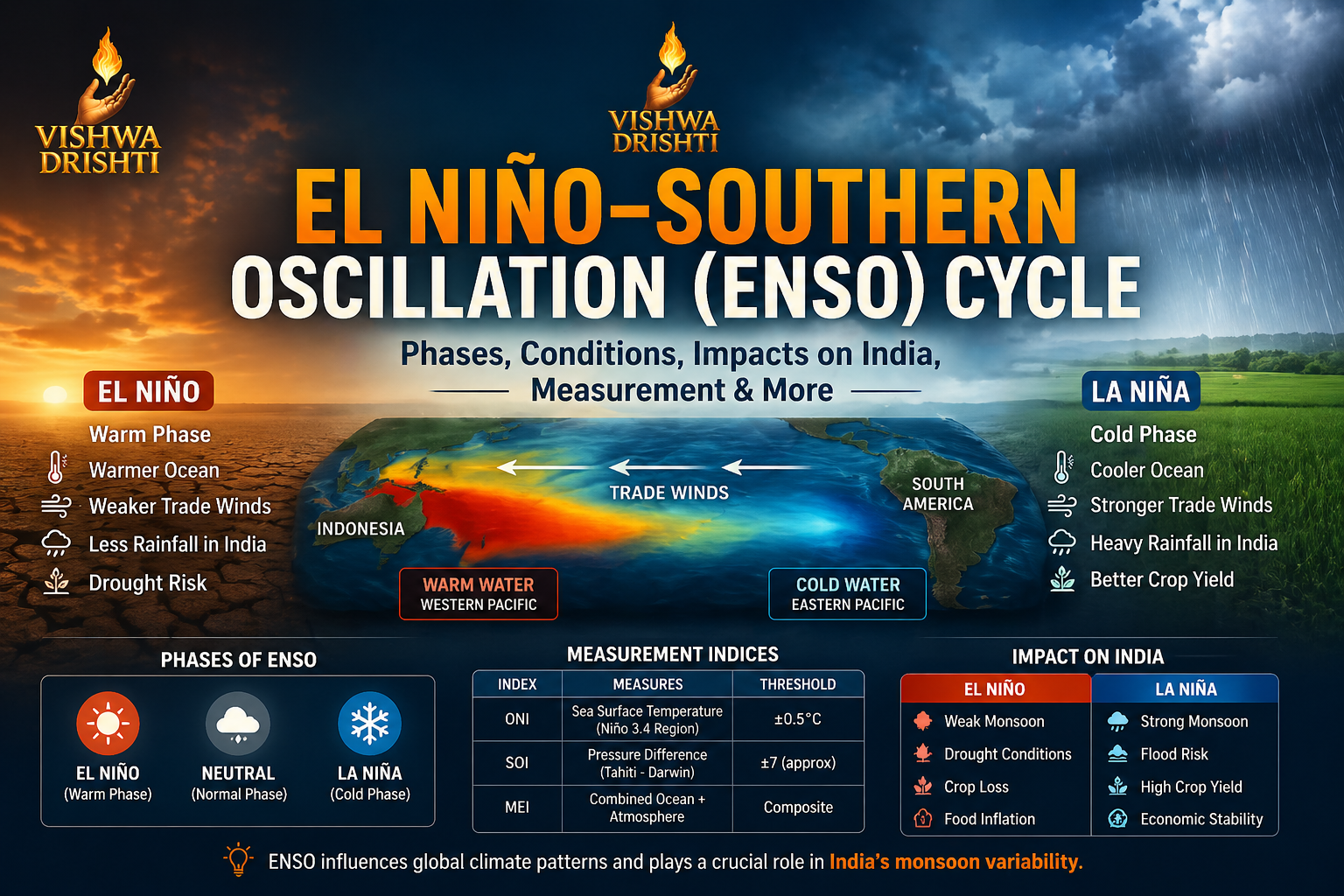
El Niño–Southern Oscillation (ENSO) Cycle
Tags: geography, climatology, environment
Summary: ENSO is a coupled ocean–atmosphere phenomenon in the Pacific Ocean that drives global climate variability and significantly affects the Indian monsoon.
1. What is ENSO?
The El Niño–Southern Oscillation (ENSO) is a periodic climate pattern caused by variations in:
-
Sea Surface Temperature (SST) in the equatorial Pacific Ocean
-
Atmospheric pressure (Southern Oscillation)
Phases of ENSO
| Phase | Nature | Core Feature |
|---|
| El Niño | Warm phase | Warming of central/eastern Pacific |
| La Niña | Cold phase | Cooling of central/eastern Pacific |
| Neutral | Normal phase | No major anomaly |
2. Normal (Neutral) Conditions
| Component | Condition |
|---|
| Trade Winds | Blow from east to west |
| Warm Water | Accumulates near Indonesia |
| Cold Water | Upwelling near South America |
| Walker Circulation | Strong |
| Rainfall | Good rainfall in India & SE Asia |
3. El Niño Phase (Warm Phase)
| Aspect | Description |
|---|
| Trade Winds | Weaken or reverse |
| SST | Warmer than normal (> +0.5°C) |
| Ocean Movement | Warm water shifts eastward |
| Upwelling | Weak or stops |
| Walker Circulation | Weakens |
Impacts
| Region | Impact |
|---|
| India | Weak monsoon, drought |
| South America | Heavy rainfall, floods |
| Australia | Drought |
| Fisheries (Peru) | Collapse due to lack of nutrients |
4. La Niña Phase (Cold Phase)
| Aspect | Description |
|---|
| Trade Winds | Stronger than normal |
| SST | Cooler than normal (< -0.5°C) |
| Ocean Movement | More warm water pushed west |
| Upwelling | Strong |
| Walker Circulation | Strengthens |
Impacts
| Region | Impact |
|---|
| India | Strong monsoon, floods |
| Australia | Heavy rainfall |
| South America | Dry conditions |
| Agriculture (India) | Higher productivity |
5. Southern Oscillation (Atmospheric Component)
| Parameter | Description |
|---|
| Measurement | Pressure difference between Tahiti & Darwin |
| Index | Southern Oscillation Index (SOI) |
| SOI Value | Interpretation |
|---|
| Positive | La Niña |
| Negative | El Niño |
6. ENSO Measurement Indices
| Index | Measures | Key Region / Feature | Threshold |
|---|
| ONI (Oceanic Niño Index) | SST anomaly | Niño 3.4 region | ±0.5°C |
| SOI | Pressure difference | Tahiti–Darwin | ±7 (approx) |
| MEI | Combined index | Ocean + atmosphere | Composite |
7. Super El Niño
| Feature | Description |
|---|
| Definition | Extremely strong El Niño event |
| SST Anomaly | > +2.0°C |
| Frequency | Rare |
| Impact | Severe global climate disruptions |
Major Events
| Year | Impact |
|---|
| 1982–83 | Global weather disruption |
| 1997–98 | Severe floods & droughts |
| 2015–16 | Strong warming, global effects |
8. Impact on India
El Niño vs La Niña
| Factor | El Niño | La Niña |
|---|
| Monsoon | Weak | Strong |
| Rainfall | Deficit | Excess |
| Agriculture | Crop loss | High yield |
| Economy | Inflation risk | Stability/improvement |
9. Indian Ocean Dipole (IOD) Interaction
| IOD Phase | Effect on Monsoon |
|---|
| Positive IOD | Strengthens monsoon |
| Negative IOD | Weakens monsoon |
10. Importance for India
| Factor | Detail |
|---|
| Agriculture Dependence | ~60% on monsoon |
| ENSO Influence | Explains ~30–40% variability |
| Relevance | Food security, economy, disaster management |
11. Conclusion
ENSO is a critical driver of global climate variability. Its phases directly influence:
-
Monsoon patterns
-
Agricultural productivity
-
Disaster events
Understanding ENSO is essential for climate prediction and policy planning.