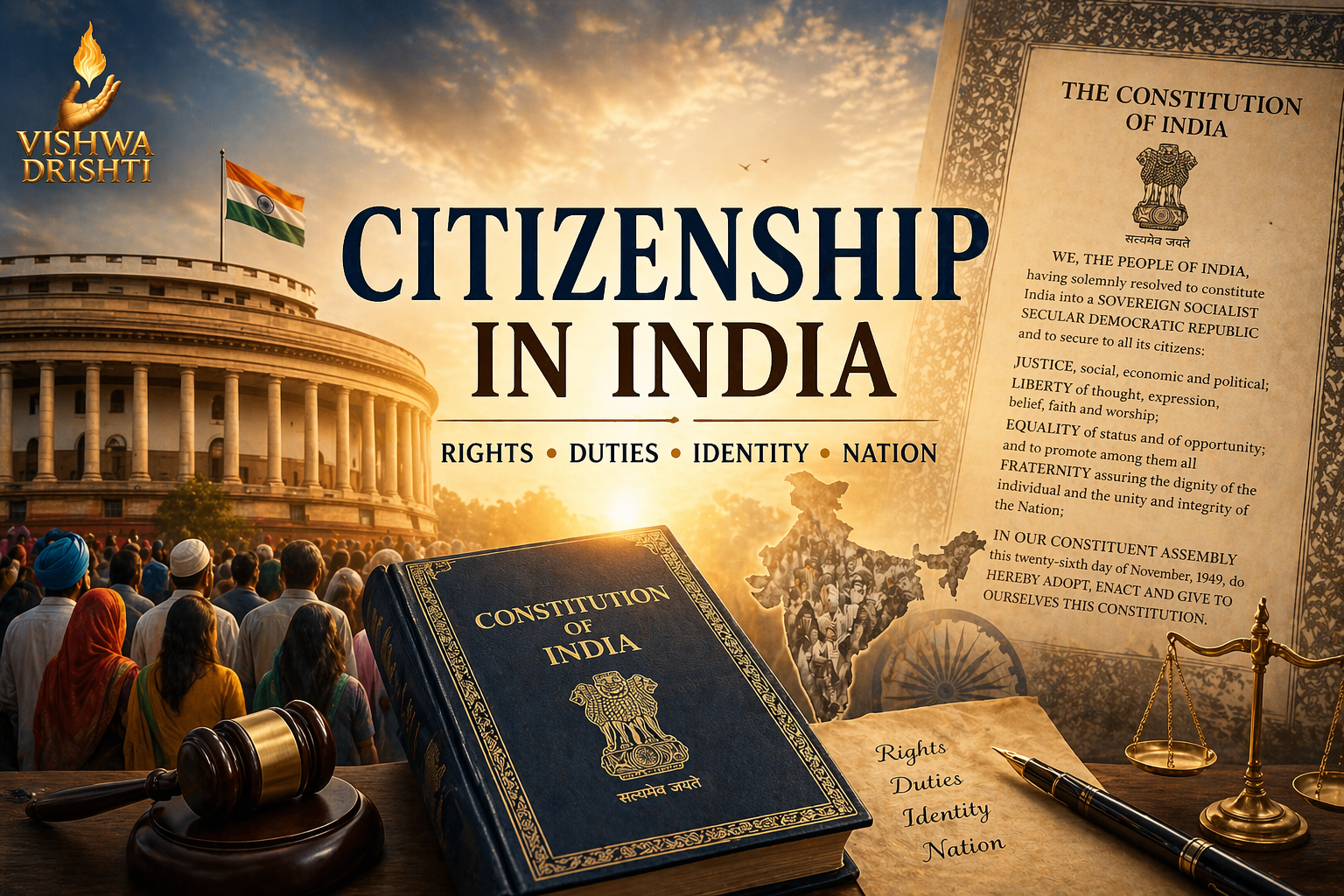
Citizenship defines the legal relationship between an individual and the State. It grants rights like voting, equality, and protection, while also imposing duties.
In India, citizenship is governed by both:
- The Constitution (Part II: Articles 5–11)
- Citizenship Act, 1955
📜 Constitutional Provisions (Articles 5–11)
| Article | Provision |
|---|---|
| Article 5 | Citizenship at the commencement of the Constitution |
| Article 6 | Citizenship of migrants from Pakistan |
| Article 7 | Citizenship of migrants to Pakistan |
| Article 8 | Citizenship of Indians abroad |
| Article 9 | No dual citizenship |
| Article 10 | Continuance of citizenship |
| Article 11 | Parliament’s power to regulate citizenship |
👉 Important: The Constitution only defines who was a citizen in 1950. Future citizenship is governed by law.
⚖️ Citizenship Act, 1955
This is the core law governing citizenship in India.
🧩 Modes of Acquiring Citizenship
| Method | Description |
|---|---|
| By Birth | Based on place of birth (with conditions over time) |
| By Descent | Through parents |
| By Registration | For certain categories like spouses |
| By Naturalization | After fulfilling residency requirements |
| By Incorporation of Territory | If new territory becomes part of India |
🧠 Evolution of Citizenship by Birth
| Period | Rule |
|---|---|
| 1950–1987 | Anyone born in India = citizen |
| 1987–2004 | One parent must be Indian |
| After 2004 | One parent Indian + other not illegal migrant |
❌ Loss of Citizenship
| Method | Explanation |
|---|---|
| Renunciation | Voluntary giving up |
| Termination | Acquiring foreign citizenship |
| Deprivation | Government removes (fraud, disloyalty, etc.) |
🚫 No Dual Citizenship in India
India does NOT allow dual citizenship.
However, it provides:
👉 OCI (Overseas Citizen of India)
OCI Benefits:
- Lifelong visa
- No need for police reporting
Limitations:
- No voting rights
- Cannot hold constitutional posts
🔥 Contemporary Issues
1. Citizenship Amendment Act (CAA), 2019
-
Provides fast-track citizenship to:
- Hindus, Sikhs, Buddhists, Jains, Parsis, Christians
- From Pakistan, Afghanistan, Bangladesh
- Excludes Muslims → led to debates on equality
2. NRC (National Register of Citizens)
- Identifies illegal migrants
-
First implemented in Assam
3. NPR (National Population Register)
- Database of residents
- Linked to NRC debate
⚖️ Key Constitutional Debate
👉 Whether citizenship laws violate:
- Article 14 (Equality)
-
Secularism (Basic Structure Doctrine)
🧠 Conceptual Clarity
Citizenship vs Nationality
Citizenship Nationality Legal status Emotional/ethnic identity Rights-based Cultural concept