
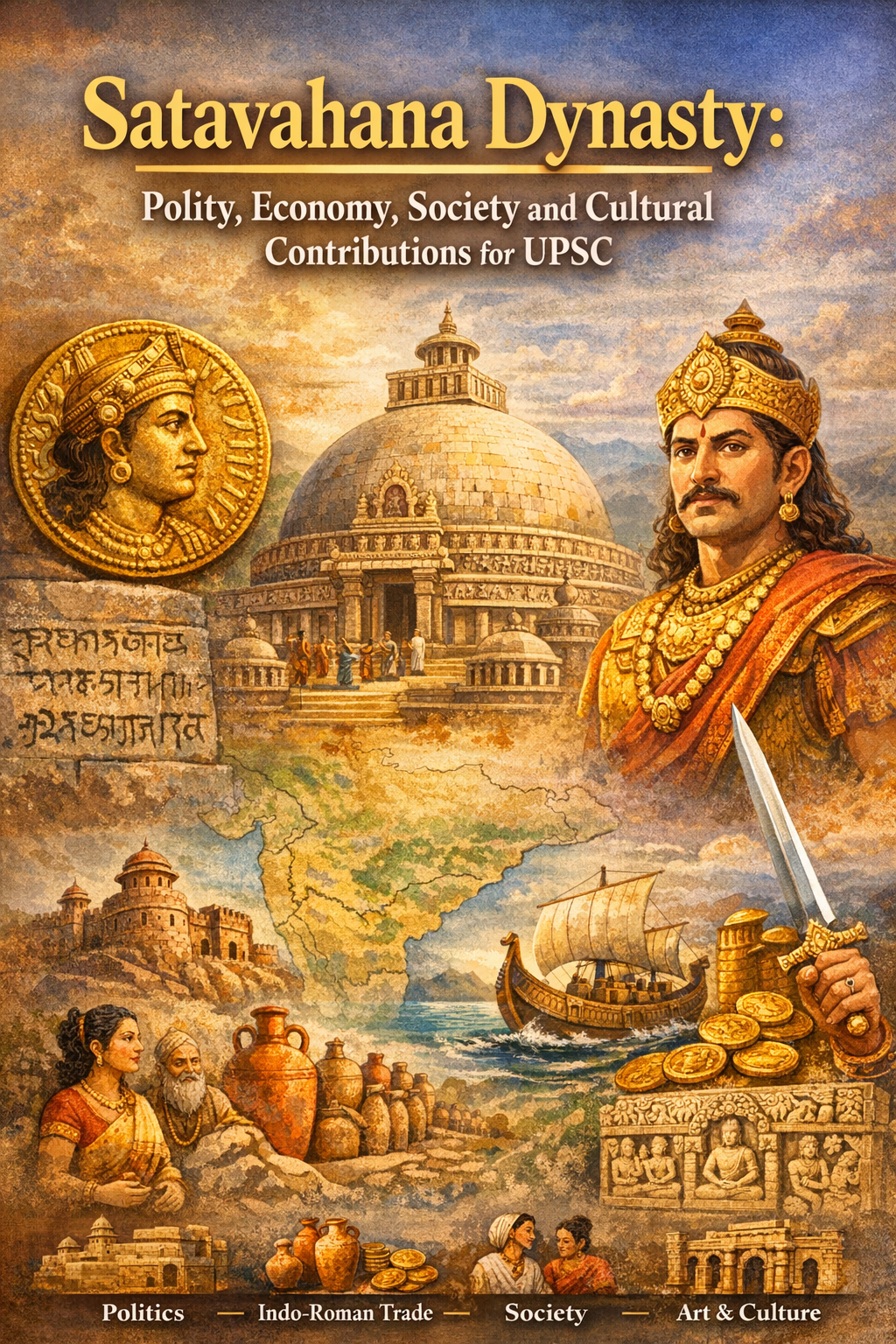
🏛️ 1. Political Structure & Administration
| Feature | Details | Keywords |
|---|---|---|
| Nature of State | Monarchical | Centralized Kingship |
| King’s Role | Supreme authority, protector of Dharma | Divine Legitimacy |
| Administrative Units | Aharas (districts) | Decentralization |
| Officials | Amatyas, Mahamatras | Bureaucracy |
| Land Grants | Given to Brahmins & institutions | Proto-feudalism |
👉 Mains Insight:
➡️ Satavahanas show transition from centralized to decentralized polity due to land grants.
💰 2. Economy & Trade
| Aspect | Details | Keywords |
|---|---|---|
| Agriculture | Main occupation | Agrarian Base |
| Trade Type | Inland + Maritime | Commercial Expansion |
| Foreign Trade | With Roman Empire | Indo-Roman Trade |
| Exports | Spices, textiles, beads | Luxury Trade |
| Imports | Gold coins | Bullion Inflow |
| Urban Centres | Paithan, Tagara, Amaravati | Urbanization |
👉 Mains Insight:
➡️ Trade led to urban growth + monetization of economy.
🧬 3. Society (Social Structure)
| Feature | Details | Keywords |
|---|---|---|
| Varna System | Present but flexible | Social Mobility |
| Women Status | High (e.g., inscriptions by royal women) | Gender Agency |
| Marriage | Inter-caste marriages existed | Flexibility |
| Social Groups | Merchants, artisans, guilds | Emerging Middle Class |
👉 Example: Gautami Balashri
👉 Mains Insight:
➡️ Society was less rigid and more inclusive than northern regions.
🛕 4. Religion & Culture
| Aspect | Details | Keywords |
|---|---|---|
| Religions | Brahmanism + Buddhism | Religious Tolerance |
| Patronage | Donations to stupas, monasteries | State Support |
| Rituals | Vedic sacrifices (Ashvamedha) | Brahmanical Revival |
👉 Mains Insight:
➡️ Coexistence reflects syncretic culture.
🎨 5. Art & Architecture
| Feature | Details | Keywords |
|---|---|---|
| School of Art | Amaravati School | Sculptural Excellence |
| Architecture | Rock-cut caves (Karle, Nasik) | Buddhist Architecture |
| Influence | Indigenous + Foreign (Greco-Roman) | Cultural Synthesis |
👉 Mains Insight:
➡️ Art reflects trade prosperity + cultural exchange.
🪙 6. Coinage System
| Feature | Details | Keywords |
|---|---|---|
| Materials | Lead, copper, silver | Unique Coinage |
| Symbols | Ships, rulers’ images | Maritime Trade |
| Language | Prakrit inscriptions | Linguistic Evidence |
👉 Mains Insight:
➡️ Coinage indicates economic activity + political authority.
⚔️ 7. Decline of Satavahanas
| Cause | Explanation | Keywords |
|---|---|---|
| Weak Successors | Lack of strong rulers | Political Instability |
| External Pressure | Conflict with Western Kshatrapas | Regional Rivalry |
| Land Grants | Reduced central control | Feudal Fragmentation |
👉 Example: Conflict with Nahapana
👉 Mains Insight:
➡️ Decline shows impact of decentralization on state stability.
🧠 8. Conclusion (Use in Mains)
👉 The Satavahanas played a crucial role in state formation in the Deccan, promoted long-distance trade, and fostered a culturally inclusive society, making them a key link between northern and southern India.
Mains Value Addition
Quote for Essay/Answers
"“Political unity and economic exchange shaped early Indian civilization.” – Adapted historical insight"
Key Data & Statistics
Indo-Roman trade flourished: Large number of Roman gold coins found in Deccan, Satavahanas issued lead coins, unique in Indian history