
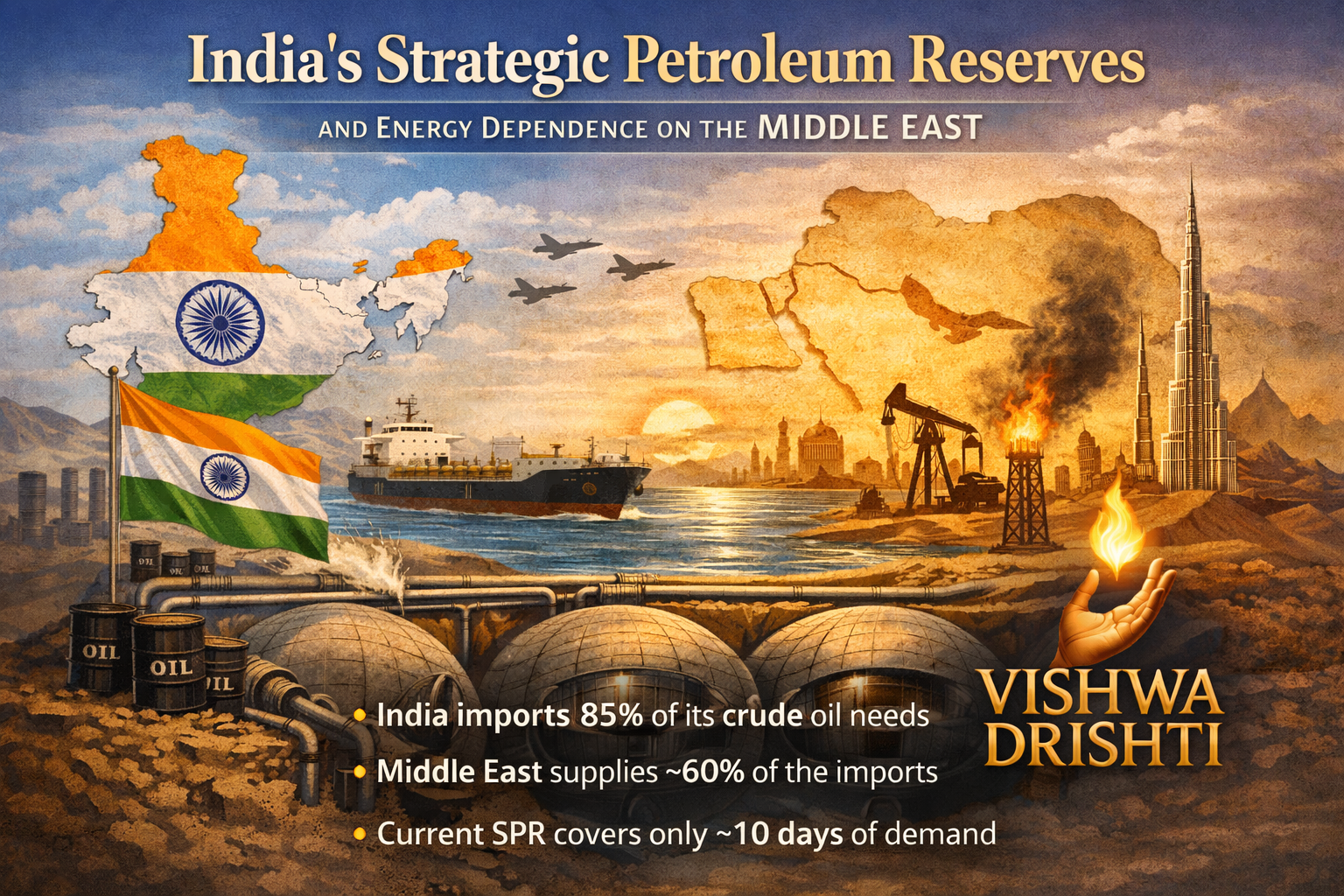
India, the world’s third-largest energy consumer, faces a structural challenge of high import dependence for crude oil. With nearly 85% of its oil needs met through imports, and a significant share coming from the Middle East, India’s energy security remains vulnerable to geopolitical disruptions and price volatility. In this context, Strategic Petroleum Reserves (SPR) emerge as a critical buffer to safeguard national interests.
India’s Energy Dependence on the Middle East
India imports a majority of its crude oil from countries such as Iraq, Saudi Arabia, UAE, and Kuwait, making the Middle East its primary energy supplier.
Reasons for Dependence
- Geographical proximity reducing freight costs
- Long-standing diplomatic and trade relations
- Availability of compatible crude grades
- Limited domestic production capacity
Associated Risks
- Geopolitical tensions (e.g., conflicts in the Persian Gulf)
- Supply disruptions due to wars or sanctions
- Oil price shocks impacting inflation and fiscal stability
-
Strategic vulnerability due to over-reliance
Strategic Petroleum Reserves (SPR): Concept and Importance
Strategic Petroleum Reserves are emergency stockpiles of crude oil maintained to ensure supply during crises.
Significance
- Acts as a buffer against supply disruptions
- Helps in price stabilization during global shocks
- Enhances strategic autonomy
- Supports energy security planning
India’s SPR is managed by the Indian Strategic Petroleum Reserves Limited (ISPRL).
India’s SPR Infrastructure
Operational Reserves (Phase I)
| Location (State) | Site | Capacity (MMT) | Operational Year |
|---|---|---|---|
| Andhra Pradesh | Visakhapatnam | 1.33 | 2015 |
| Karnataka | Mangaluru | 1.5 | 2016 |
| Karnataka | Padur | 2.5 | 2018 |
| Total | — | 5.33 MMT | — |
➡️ Covers roughly 9–10 days of India’s crude oil demand
Upcoming Projects (Phase II)
| Location (State) | Site | Capacity (MMT) | Status |
|---|---|---|---|
| Odisha | Chandikhol | 4.0 | Under development |
| Karnataka | Padur (Expansion) | 2.5 | Approved |
| Total | — | 6.5 MMT | — |
➡️ Expected to increase coverage to ~20+ days
Proposed Future Expansions
- Bikaner (Rajasthan) – Salt cavern storage
- Bina (Madhya Pradesh) – Inland reserve
-
PPP-based expansion model for private participation
Challenges in India’s SPR Strategy
1. Limited Capacity
India’s SPR covers only ~10 days, far below the 90-day benchmark recommended by the International Energy Agency.
2. High Costs
Construction and maintenance of underground caverns require significant investment.
3. Regional Concentration
Most reserves are located along the western and eastern coasts, increasing vulnerability to localized risks.
4. Import Dependency Persists
SPR is only a temporary buffer and does not reduce structural dependence.
Government Initiatives
- Expansion under Phase II projects
- Diversification of imports (USA, Russia, Africa)
- Promotion of renewable energy (solar, green hydrogen)
- Ethanol blending and EV push
-
Strategic oil storage partnerships (e.g., UAE)
Way Forward
- Expand SPR capacity to approach 90-day reserves
- Strengthen domestic exploration (HELP policy)
- Diversify energy basket toward renewables and nuclear
- Enhance energy diplomacy beyond the Middle East
-
Promote energy efficiency and electric mobility
Conclusion
India’s heavy dependence on the Middle East for energy is both an economic necessity and a strategic vulnerability. While Strategic Petroleum Reserves provide a critical safety net, they are not a permanent solution. A balanced approach involving SPR expansion, diversification of imports, and transition to renewable energy is essential for ensuring long-term energy security and strategic autonomy.
Mains Value Addition
Quote for Essay/Answers
"“Energy security is at the heart of national security.” – Narendra Modi"
Key Data & Statistics
India imports ~85% of its crude oil needs, Around 60% of imports come from the Middle East, Current SPR capacity: ~5.33 million metric tonnes (MMT) (~9–10 days of demand),Total oil storage (including commercial): ~74 days of demand, Target (IEA benchmark): 90 days of reserves
Committee / Case Law
International Energy Agency recommendations on 90-day reserves ,NITI Aayog energy security strategy reports, Integrated Energy Policy (Planning Commission)
UPSC PYQ & Mains Practice
Discuss India’s energy security challenges in the context of rising import dependence. Suggest measures to address them.
What are the challenges to India’s energy security? How can India reduce its dependence on imported energy resources?
Discuss the role of energy resources in the economic development of India. How can India ensure sustainable energy security?