
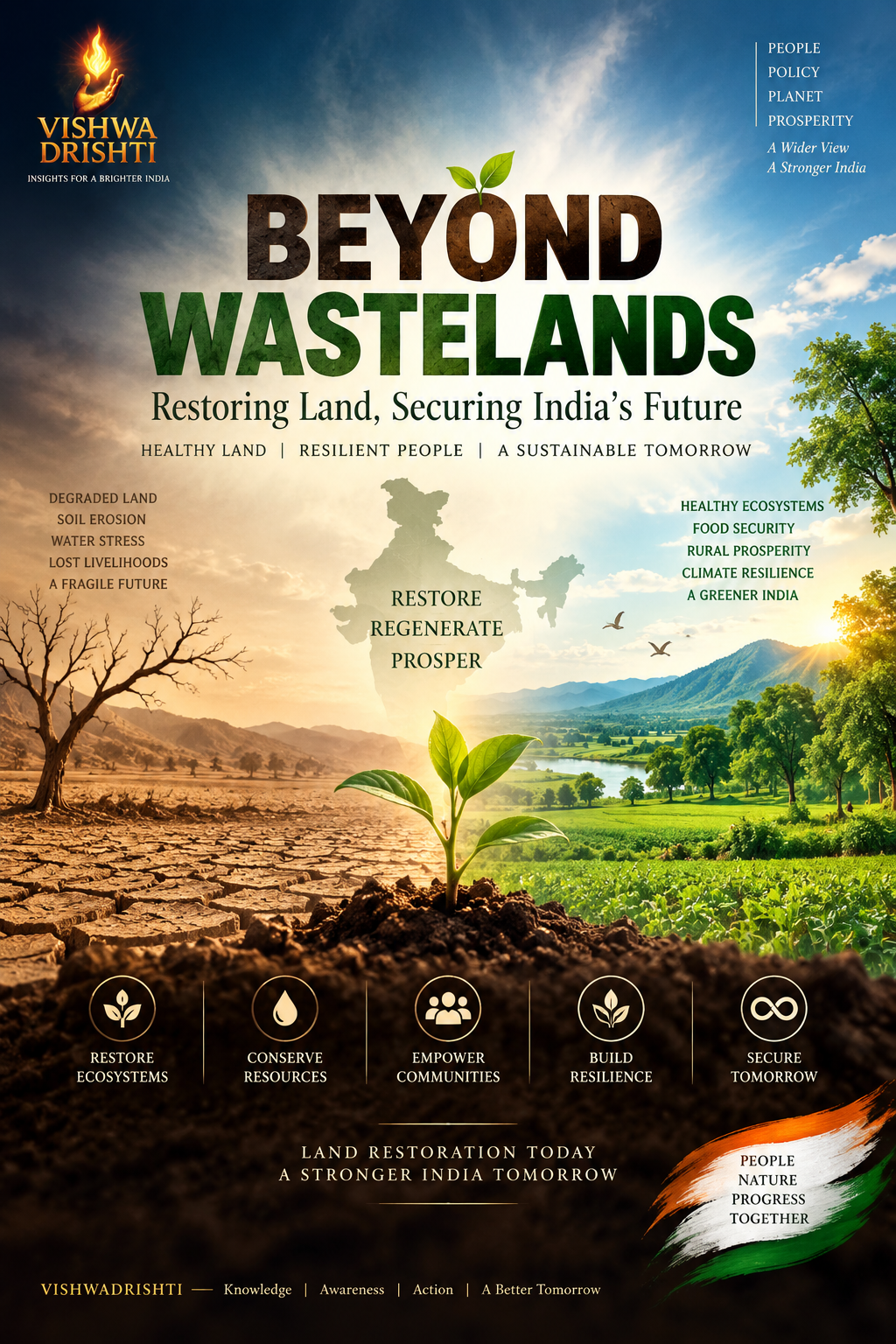
Beyond Wastelands: Restoring Land, Securing India’s Future
- Core Issue
India faces a dual challenge:
Land degradation → declining productivity → water stress → livelihood insecurity → ecological degradation → climate vulnerability.
NITI Aayog cites estimates that around 30% of India's geographical area is degraded, while a World Bank assessment puts degraded land at about 96 million hectares.
The issue is therefore not merely about “unused land”; it is about restoring ecological productivity and securing livelihoods.
- Important Statistics for Mains Fact How to use ~30% of India's land is affected by degradation/desertification Establish magnitude ~96 million ha affected by land degradation in a World Bank assessment Quantify challenge Land degradation cost estimated at ~2.5% of GDP (2014–15) Economic dimension Around 85% of degraded land concentrated in dry/rainfed areas in the World Bank assessment Regional vulnerability India committed to restore 26 million ha by 2030 International commitment ~55.76 million ha classified as wasteland in NITI Aayog's GROW report Restoration opportunity ~25% geographical area under forest and tree cover, according to India State of Forest Report 2021 Ecological context
The GROW report specifically identifies 55.76 million hectares, or 16.96% of India's total geographical area, as wastelands and explores agroforestry suitability using GIS and remote sensing.
- What Causes Land Degradation? Natural factors Drought Floods Wind and water erosion Salinity Desertification Climate variability Human factors
Agriculture
Excessive chemical inputs Over-irrigation Monocropping Excessive groundwater extraction
Deforestation
Loss of vegetation cover Soil erosion Reduced carbon sequestration
Overgrazing
Loss of grass cover Soil compaction Reduced regeneration
Mining
Removal of topsoil Landscape fragmentation Pollution
Urbanisation & infrastructure
Conversion of agricultural/ecological land Soil sealing Fragmentation of ecosystems 4. The Vicious Cycle
A strong diagram for Mains:
Deforestation / overgrazing / unsustainable agriculture
↓
Vegetation loss
↓
Soil erosion
↓
Reduced soil fertility
↓
Lower agricultural productivity
↓
Greater dependence on groundwater and chemical inputs
↓
Water stress + salinity + further degradation
↓
Poverty and migration
This creates a “degradation–poverty–vulnerability cycle.”
- Why Land Restoration Matters 🌾 Food security
Healthy soil → higher productivity → greater food security.
💧 Water security
Watershed restoration improves groundwater recharge and reduces runoff.
👨🌾 Farmer livelihoods
Agroforestry and watershed development can diversify rural incomes.
🌳 Climate change
Restored forests, grasslands and soils can increase carbon storage.
🐅 Biodiversity
Habitat restoration supports ecosystems and wildlife.
🏭 Economic growth
Productive land improves agricultural and rural economic activity.
🏘️ Migration
Improved rural livelihoods can reduce distress migration.
- Famous Reports & Studies to Quote
- ISRO — Desertification and Land Degradation Atlas
ISRO's land-degradation datasets use satellite-based information and provide land-degradation data useful for planning and development.
Mains use:
“India needs to move from reactive land reclamation to satellite-based, evidence-driven landscape restoration.”
- NITI Aayog — GROW Report, 2024
Greening and Restoration of Wastelands with Agroforestry
The report uses remote sensing + GIS + soil organic carbon + slope + waterbody and land-use data to identify areas suitable for agroforestry.
Mains value: Excellent example of technology + ecology + agriculture.
- World Bank — REWARD Project
The World Bank supported a $115 million programme involving Karnataka and Odisha for modern watershed management, climate-resilient agriculture and improved farmer incomes.
Mains use:
“Watershed development can simultaneously address land degradation, water insecurity, agricultural productivity and rural livelihoods.”
- UNCCD — Land Degradation Neutrality
UNCCD defines Land Degradation Neutrality around maintaining or increasing the quantity and quality of land resources needed for ecosystem functions and food security.
Its approach broadly involves:
Avoid → Reduce → Reverse
land degradation.
- India's Major Government Initiatives 🌱 Green India Mission
Focus:
Increase forest/tree cover Improve ecosystem services Enhance carbon sequestration Improve climate resilience 💧 PMKSY — Watershed Development Component
Focus:
Rainwater harvesting Soil conservation Watershed treatment Sustainable agriculture 🌳 National Agroforestry Policy
Promotes integration of:
Trees + Crops + Livestock
to improve productivity and ecological resilience.
🏜️ Desertification and Land Degradation Atlas
Provides scientific information for identifying and monitoring degraded areas.
🌾 Soil Health Card Scheme
Promotes balanced fertiliser use and improved soil management.
🌍 Compensatory Afforestation
Aims to compensate for forest diversion through afforestation and related ecological measures.
🌿 MGNREGA
Can support:
Water conservation Plantation Land development Drought-proofing Natural resource management 8. Important Case Studies Case Study 1 — Ralegan Siddhi, Maharashtra
Community-led watershed development demonstrated how:
water conservation + community participation + agriculture
can transform a degraded rural landscape.
Mains takeaway:
Local participation is critical for sustainable restoration.
Case Study 2 — Hiware Bazar, Maharashtra
Watershed development and water budgeting helped improve agricultural productivity and rural livelihoods.
Keywords: Water budgeting, community participation, groundwater management.
Case Study 3 — Karnataka Watershed Development
The Karnataka Watershed Development Project used satellite imagery and integrated watershed planning across rainfed districts.
Mains takeaway:
Geospatial technology can make watershed restoration targeted rather than generic.
Case Study 4 — Karnataka & Odisha: REWARD
Modern watershed practices are being used to improve agricultural resilience, productivity and farmer incomes.
- Constitutional Angle
Very useful for GS-II + GS-III.
Article 21
Right to life has been judicially interpreted to include a healthy environment.
Article 48A
State should protect and improve the environment and safeguard forests and wildlife.
Article 51A(g)
Citizens have a fundamental duty to protect the natural environment.
Article 39(b)
Resources of the community should be distributed to subserve the common good.
- SDG Connection SDG 2
Zero Hunger
SDG 6
Clean Water and Sanitation
SDG 13
Climate Action
SDG 15
Life on Land
SDG 15 directly addresses sustainable terrestrial ecosystems, desertification, land degradation and biodiversity loss. India's SDG Index also tracks progress under this goal.
- International Commitments UNCCD
India is a party to the United Nations Convention to Combat Desertification.
Land Degradation Neutrality
India has committed to restoring 26 million hectares of degraded land by 2030.
SDG Target 15.3
Achieve Land Degradation Neutrality by 2030.
Paris Agreement
Land restoration contributes to:
Carbon sequestration Climate adaptation Ecosystem resilience 12. Biggest Challenges
- Fragmented governance
Land, forests, water and agriculture are handled by different institutions.
- Plantation-centric approach
More trees ≠ automatically more restoration.
Wrong species or monoculture plantations can damage native ecosystems.
- Community exclusion
Restoration may fail when local communities are not involved.
- Land-tenure issues
Unclear ownership discourages long-term investment.
- Water-intensive agriculture
Restoring land without correcting unsustainable water use can recreate degradation.
- Weak monitoring
Projects often measure trees planted, rather than:
survival rate soil health groundwater recharge biodiversity farmer income 7. Climate change
Heat waves, droughts and extreme rainfall can reverse restoration gains.
- Critical Analysis
A high-quality UPSC answer should not simply say “plant more trees.”
The real principle should be:
“Right ecosystem + right species + right place + right community + right technology.”
For example, natural grasslands should not automatically be converted into forests. Restoration must be ecosystem-specific.
UNCCD's LDN principles also emphasise protecting land-based natural capital while safeguarding human well-being and the rights of land users.
Way Forward 5R Framework
Restore
Degraded forests Grasslands Wetlands Agricultural soils
- Regenerate
Native vegetation Natural regeneration Soil biodiversity
- Reuse
Productively utilise suitable wastelands through agroforestry and sustainable land uses.
- Reconcile
Balance agriculture, infrastructure, livelihoods and conservation.
- Remote-monitor
Satellite imagery GIS AI Drones Soil and groundwater monitoring 15. Most Important Mains Keywords
Use these words to make your answer look analytical:
Land Degradation Neutrality
Landscape approach
Nature-based solutions
Climate-resilient agriculture
Agroforestry
Watershed management
Natural regeneration
Soil organic carbon
Ecosystem services
Green infrastructure
Community-based natural resource management
Geospatial technology
Convergence approach
Ecological restoration
Climate adaptation
Resource-use efficiency
- Best Mains Introduction
“Land is not merely a physical resource; it is the foundation of food security, livelihoods, biodiversity and ecological stability. In India, where nearly 30% of the geographical area is affected by land degradation, restoring degraded landscapes is therefore not an environmental luxury but a developmental necessity.”
- Best Mains Conclusion
“India must move from viewing degraded land as ‘wasteland’ to recognising it as an opportunity for ecological and economic regeneration. A landscape-based approach integrating watershed management, agroforestry, natural regeneration, community participation and geospatial technology can convert land restoration into a pathway for food, water, livelihood and climate security.”
⭐ One-line value addition
“The objective should not be merely to green the land, but to restore its ecological functions and the livelihoods dependent upon them.”
Mains Value Addition
Quote for Essay/Answers
"The objective should not merely be to green the land, but to restore its ecological functions and the livelihoods dependent upon them."
Key Data & Statistics
India has committed to restore 26 million hectares of degraded land by 2030 under its Land Degradation Neutrality commitment.
Committee / Case Law
UNCCD’s Land Degradation Neutrality (LDN) approach: Avoid → Reduce → Reverse land degradation.
UPSC PYQ & Mains Practice
Land degradation / environmental degradation / sustainable development themes
Environmental pollution, climate change and sustainable development themes
Environmental impact, climate change and sustainable resource management